Watches as Alternative Assets in 2025: The Complete Investment Guide
For decades, alternative asset allocation meant some combination of private equity, real estate, hedge funds, fine art, and gold. Luxury watches were absent from the conversation, dismissed as consumption goods regardless of their resale dynamics. That position is no longer defensible. The global secondary watch market reached $16.73 billion in 2025, up 36.4% year-over-year, with dedicated watch funds now managing $2.1 billion in AUM across eight major vehicles. Family offices have begun allocating to watches alongside fine art and rare automobiles. The institutional infrastructure has caught up to the underlying performance, and the discipline of evaluating watches as alternative assets is now a question of doing the work, not of whether the work is worth doing.
What Makes a Watch an Alternative Asset
An asset earns the “alternative” label by exhibiting three characteristics: low correlation to traditional public markets, a defensible scarcity dynamic, and a functioning resale market with established price discovery. Luxury watches now satisfy all three.
Scarcity is the most fundamental. Rolex produces approximately one million watches annually. Patek Philippe produces around 70,000. Audemars Piguet produces roughly 50,000. A. Lange & Söhne produces under 5,500. These production volumes have remained essentially flat for over a decade against demand growth of multiples, creating the textbook conditions for sustained price support on desirable references.
Liquidity has been the structural breakthrough. A decade ago, selling a watch meant a dealer haircut of 20% to 30% and a transaction window of weeks to months. The institutionalisation of the secondary market through platforms like WatchCharts, which maintains transparent indices and historical transaction data for every major reference, has compressed spreads materially. Top-tier Rolex sport models now sell in a median of fifteen to twenty days at prices that are publicly verifiable before the transaction. That liquidity profile is competitive with prime residential real estate and superior to private equity.
The store-of-value properties have been empirically validated. Knight Frank’s Wealth Report documented that watch prices rose 147% over the most recent ten-year window, outperforming vintage cars (118%) and diamonds (13%). Investment-grade limited editions have appreciated more dramatically: a $5,000 watch purchased in 2009 now commands $19,500 to $20,700 in 2025 transaction values, equivalent to roughly 9% compound annual growth without management fees or carry.
The Watch Market by the Numbers
The size of the luxury watch market depends on methodology. Statista’s published figure for 2025 sits at $63.72 billion in global luxury watch revenue, growing at a 3.82% CAGR through 2030. Fortune Business Insights estimates $57.83 billion in 2025, growing at 8.47% to $119.48 billion by 2034. The secondary market is the relevant figure for investors. At $16.73 billion in 2025, with dealer sales contributing $15.65 billion (up 38.3% year-over-year) and auction channels generating $1.09 billion (up 14%), the secondary market is now approaching the primary market in volume.
Geographic concentration tells a useful story. Hong Kong accounts for 34% of million-dollar watch transactions globally. Switzerland represents 28%. The United States 22%. London sits within the European market that holds 41.77% of global market share at $15.9 billion. The UK luxury watch market alone is $5.19 billion in 2025, approximately 8.97% of global revenue. For a London-based finance professional, this concentration of high-end transaction activity means access to depth of inventory and authentication infrastructure that buyers in most markets simply do not have.
The Deloitte consumer research reinforces the institutional shift. Twenty percent of consumers surveyed in January 2024 intended to buy a pre-owned watch within the following year, double the figure from 2020. This is not a niche collector dynamic. It is mainstream behavioural change among the demographics that drive luxury consumption broadly.
The 2025 data also bifurcates the market sharply. Million-dollar transactions reached 79 sales globally, with institutional-grade Patek Philippe references retaining 85% to 92% of purchase prices over five-year holding periods. Commodity-tier inventory below £5,000, by contrast, has appreciated minimally and shows weak liquidity. The investment case concentrates in specific brands and references, not in the broad market.
Which Watch Brands Make the Best Investments
The brand-level performance distribution is heavily skewed. Five categories warrant allocation consideration, and pricing reference data across all of them is available on Chrono24, the largest aggregated marketplace for pre-owned luxury watches.
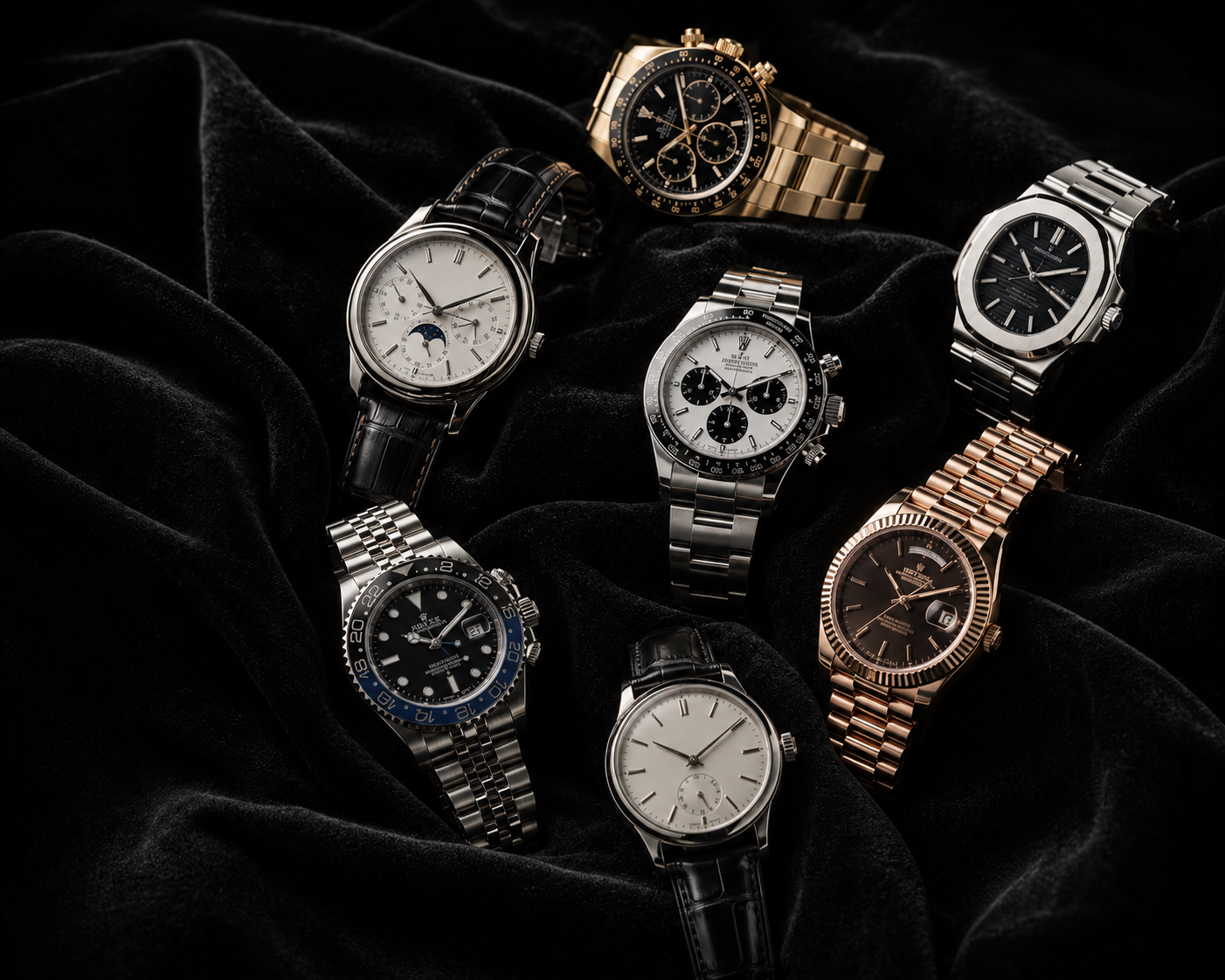
Rolex is the foundation of any watch portfolio. Fifteen-year compound returns of approximately 10.6% annualised across the major collections, combined with the most liquid global secondary market in the category, makes Rolex the equivalent of a core allocation. The Submariner at £8,100 retail, Daytona at £13,600, GMT-Master II Pepsi at £9,850 retail (trading at £25,100 secondary), and Day-Date 40 in yellow gold at approximately £35,000 represent the highest-conviction references. For deeper analysis of Rolex’s store-of-value characteristics, see Rolex as a Store of Value: A Data-Driven Analysis.
Patek Philippe sits at the top of the investment hierarchy. The Nautilus and Aquanaut references have historically traded at multiples of retail (the 5711/1A peaked above $200,000 secondary against approximately $30,000 retail before correcting). The Calatrava offers more stable economics with lower volatility, with select references trading 5% to 15% above retail in full-set condition. Patek’s institutional-grade references hold 85% to 92% of value over five years, the strongest retention metric in the category.
Audemars Piguet is concentrated almost entirely in the Royal Oak collection. The 15500ST and 15510ST steel references have followed the same pandemic-era spike and correction as Patek’s sport references, with current secondary pricing 30% to 80% above retail depending on configuration. Outside the Royal Oak, AP’s investment case is thinner; the Code 11.59 collection has not gained collector traction commensurate with its retail positioning.
A. Lange & Söhne rewards connoisseurship rather than capital appreciation. The Lange 1 and Saxonia references hold value with dignity rather than appreciating dramatically. Aventurine dial versions and limited editions trade above retail. For investors prioritising preservation over growth, particularly in the £20,000 to £40,000 range, Lange offers the strongest combination of finishing quality and store-of-value properties outside the Rolex/Patek duopoly.
Independent makers (F.P. Journe, Voutilainen, Akrivia, Rexhep Rexhepi, De Bethune) represent the highest-return segment of the watch market but with materially lower liquidity. F.P. Journe Chronometre Bleu, retail approximately £25,000 a few years ago, now trades at £80,000 to £120,000. The independents are the watch equivalent of late-stage venture: extreme upside, multi-month transaction windows, narrow buyer pools, and authentication risk that requires genuine specialist knowledge. Allocate sparingly.
How to Build a Watch Portfolio from £5,000
Portfolio construction in watches follows the same logic as any concentrated alternatives allocation: start with the most liquid and recognisable assets, add specificity as capital expands.
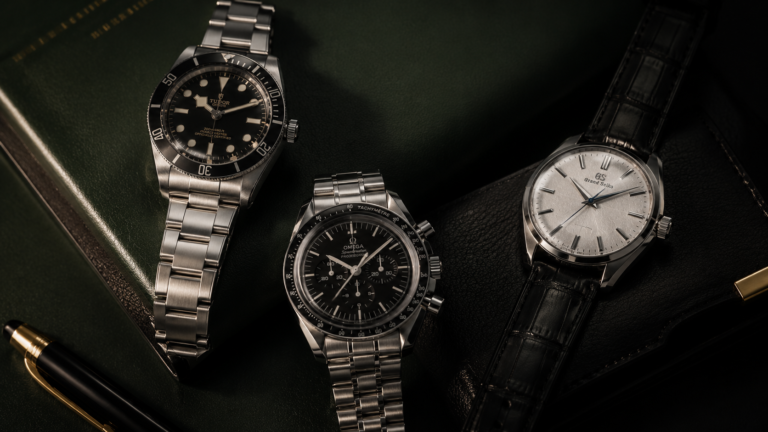
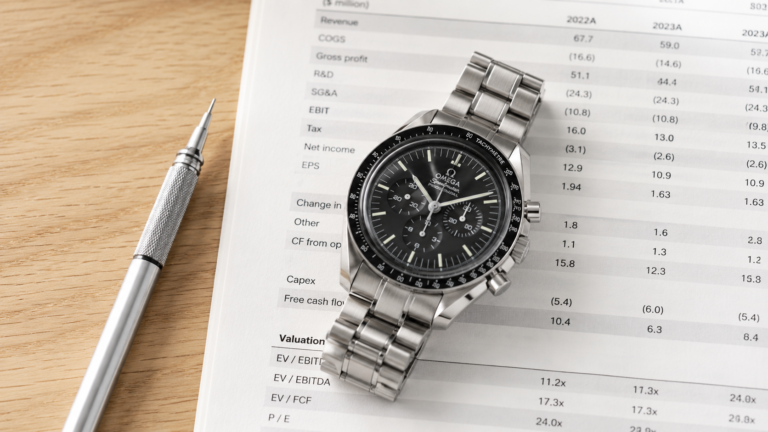
£5,000 to £10,000 entry. A single watch from a brand with credible institutional positioning. The Tudor Black Bay 58 at £3,050 to £3,350 (see Tudor Black Bay 58 vs Rolex Submariner for a detailed comparison), a pre-owned Rolex Datejust in steel at £6,000 to £8,000, or an Omega Speedmaster Professional at £6,500 retail. The investment outcome at this tier is modest; the goal is to enter the market with a defensible asset rather than maximise appreciation.
£10,000 to £25,000. The entry point for serious portfolio construction. One Rolex sport model acquired through an authorised dealer relationship (Submariner, Explorer, GMT-Master II Sprite or Pepsi if available). A Jaeger-LeCoultre Master Ultra Thin at £8,200 to £10,000 paired with a Rolex Datejust. A pre-owned Royal Oak 15400ST in the £20,000 to £25,000 range. Diversification at this level is across two complementary references rather than a single concentrated position.
£25,000 to £50,000. Patek Philippe Calatrava becomes accessible. A. Lange & Söhne Saxonia Thin at £18,000 to £25,000. Pre-owned Rolex Daytona steel. A three-watch portfolio at this tier might combine one Rolex sport reference, one dress watch (Calatrava or Saxonia), and one secondary holding for liquidity flexibility.
£50,000 to £100,000. The Patek Nautilus and Aquanaut secondary market opens. Royal Oak 15500ST in current production references. Lange complications (1815 Chronograph, Datograph) become viable. Entry-level independents (Akrivia Rexhep Rexhepi base references) become accessible. Portfolio diversification meaningfully improves.
£100,000 and above. Vintage Patek Philippe references, F.P. Journe and Voutilainen pieces, complicated Rolex (Daytona platinum, Sky-Dweller), and bespoke commissions. At this tier, the considerations shift from accumulation to curation, and the marginal asset should be additive to portfolio specificity rather than substitutive.
A defensible allocation framework for the overall position: no more than 5% to 10% of total alternative asset capacity, treated as a long-duration hold (five years minimum, ideally ten or more), with documentation discipline and authentication rigour applied to every acquisition.
The Risks Every Watch Investor Must Understand
Three risks dominate, and the 2022 correction demonstrated each of them in compressed form.
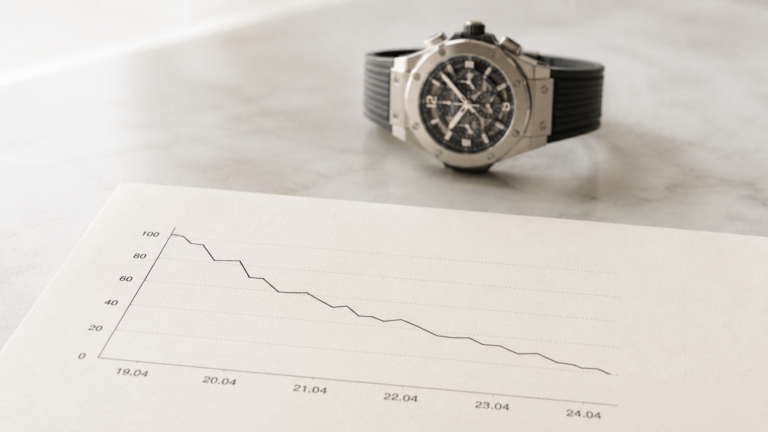
Market cycle risk. The luxury watch secondary market peaked in spring 2022 after a pandemic-era speculative cycle. Rolex sport models declined 9.7% to 12.9% over the subsequent two years. Patek Nautilus 5711 references corrected from secondary peaks above $200,000 to current trading near $100,000 to $130,000. The correction was sharper at the speculative tier (sport Rolex, Patek Nautilus, AP Royal Oak) and milder for dress watches and precious metal references. Investors who allocated near the 2022 peak experienced meaningful drawdowns. The lesson is that watches, like all alternatives, exhibit cycles, and entry timing affects outcomes.
Authentication risk. Counterfeiting has become sophisticated enough that visual inspection alone is insufficient for high-value references. Movement-level authentication requires specialist tools and expertise. The institutional channels (authorised dealers, Watchfinder & Co., Bonhams, Christie’s, Sotheby’s) mitigate this risk through warranty and provenance documentation. Private-party transactions without provenance carry materially elevated authentication risk. Discount pricing relative to reference market often signals authentication concerns rather than genuine opportunity.
Liquidity risk. Liquidity is reference-specific. A Submariner or Daytona sells in days; a complicated independent piece may take months. In a forced sale scenario, the liquidity differential translates directly into price concession. Portfolio construction should consider liquidity-weighted positioning, with at least 60% to 70% of position value in references with thirty-day median sale times.
A fourth risk warrants mention: regulatory and tax. UK personal-use chattels carry specific capital gains treatment that varies by asset class and value threshold. Cross-border transactions for buyers operating internationally introduce VAT and customs considerations. Specialist tax advice is appropriate for portfolios above £50,000.
Where to Buy and Sell Investment-Grade Watches
The acquisition channel materially affects investment outcomes. Four routes warrant consideration.
Authorised dealers offer the optimal economics for new watches but require relationship development. In London, Watches of Switzerland operates across Old Bond Street, Regent Street, Knightsbridge, Royal Exchange, and Canary Wharf. Mappin & Webb, Harrods Fine Watch Room, and Bucherer complete the major authorised dealer network. Allocation for high-demand references requires multi-year purchase history.
Online platforms with authentication. Chrono24 is the global aggregator for pre-owned luxury watches, providing price transparency and a verified seller programme. Watchfinder & Co., with Richemont group backing, offers fully authenticated and warrantied pre-owned inventory and is the institutional-grade option for buyers without dealer relationships. Bucherer Certified Pre-Owned, Rolex’s own CPO programme launched in 2023, has added a further layer of authentication infrastructure to the market.
Specialist dealers. Somlo London in the Burlington Arcade is the established choice for vintage Rolex, Patek Philippe, and German makers. Hancocks of Mayfair handles serious complicated references. These dealers carry inventory and pricing transparency that platform marketplaces cannot match for higher-value pieces.
Auction. Christie’s, Sotheby’s, Bonhams, and Phillips all maintain active London watch departments. Auction acquisition is appropriate for vintage references and complicated pieces with established provenance. Buyer’s premium adds 25% to hammer prices, and condition risk transfers fully to the buyer. For high-conviction acquisitions on rare references, auction provides access that other channels do not.
For selling, the platform choice depends on price-versus-time priorities. Watchfinder and certified pre-owned programmes offer immediate liquidity with a 10% to 20% spread to private-market pricing. Chrono24 marketplace listings achieve closer to market pricing but require seller time and authentication co-ordination. Auction maximises price for rare pieces but with multi-month transaction windows.
Once acquired, storage matters as much as authentication. A quality watch winder keeps
automatic movements running between wears and preserves service intervals over a long hold.
Conclusion: Making the Allocation Decision
The investment case for watches as alternative assets is now empirically supportable. The data is mature, the market infrastructure is institutional, and the performance metrics are competitive with established alternatives on a risk-adjusted basis.
The decision is not whether watches are an asset class. The 2025 secondary market figures, the institutional capital allocations, and the verified performance of specific brand portfolios have resolved that question. The decision is whether an allocation makes sense for your specific financial position, time horizon, and tolerance for the operational requirements (authentication discipline, documentation, storage, insurance) that watches uniquely impose.
For a London-based finance professional with multi-million pound liquid net worth, a 5% to 10% alternative asset sleeve allocation to watches is defensible on the data. Concentrate the position in Rolex and Patek Philippe references with established liquidity. Add Lange and selective independents for specificity. Build the position over time through authorised dealer relationships rather than chasing secondary market premiums. Treat it as a ten-year hold, not a trading position. Apply the same valuation rigour you would apply to any private investment.
Done with discipline, this is an alternative asset class with real returns, real liquidity, and one differentiated feature no other store of value provides: you wear it. That use value matters, and it explains why the allocation conversation has become serious rather than dismissive.
DialAndYield.com analyses luxury watches as alternative assets for finance professionals. All prices in GBP are indicative as of Q2 2026, sourced from UK authorised retailers and secondary market data. Market sizing data sourced from Statista, Fortune Business Insights, IMARC, and Knight Frank Wealth Report. Secondary market performance data sourced from WatchCharts, Chrono24, and Watchfinder & Co.