How Inflation Affects Luxury Watch Prices: A Data-Driven Analysis
Inflation is the silent destroyer of purchasing power. A pound in 2020 buys materially less in 2026, and most asset classes either struggle to keep pace with that erosion or require active management to do so. Luxury watches, for specific structural reasons, have not only kept pace with inflation across the 2020 to 2026 cycle but outperformed it by a significant margin in the references that matter. This is not an accident. It is the predictable output of controlled supply meeting sustained demand in a depreciating currency environment. The data tells a precise story, and the implications for portfolio positioning in 2026 are concrete.
The Inflation-Watch Price Relationship
The 2021 to 2023 inflationary cycle was the most significant test of watches as an inflation hedge in a generation. UK CPI rose almost continuously from under 1% in early 2021 to 11.1% in October 2022, a 41-year high, before easing over the following two years. Core inflation, which excludes volatile energy and food, peaked at 7.1% in May 2023, its highest rate since 1992.
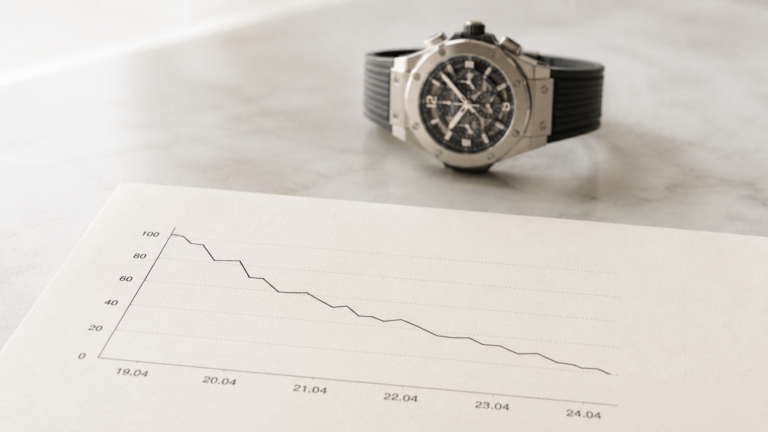
Across the same window, secondary market Rolex prices did not merely keep pace. They ran ahead. The Bloomberg Subdial Watch Index, which tracks the 50 most-traded pre-owned references, rose sharply from 2020 through the April 2022 peak, where certain Rolex and Patek Philippe references were trading at two to four times retail. The index subsequently corrected, as all assets that outrun underlying value eventually do. The critical observation is that even after the correction, most investment-grade Rolex references remained substantially above their 2020 levels.
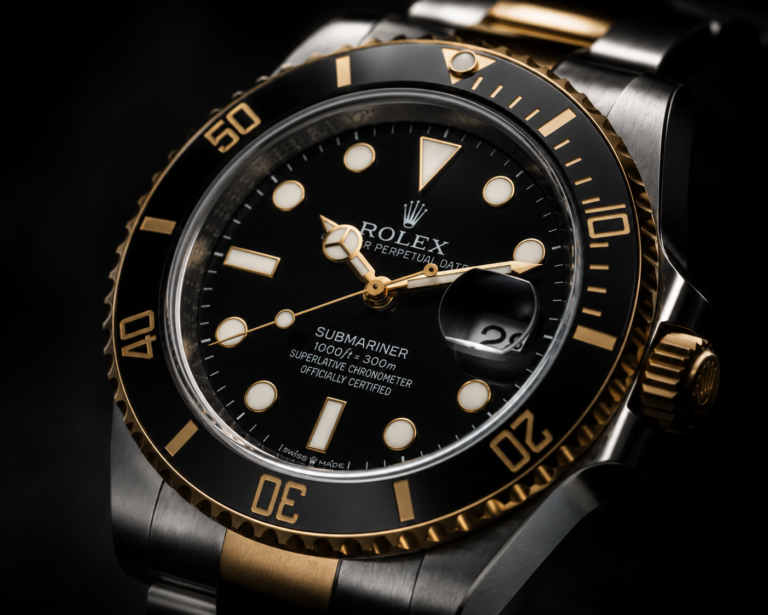
A stainless steel Cosmograph Daytona 116500LN traded around £15,000 in 2020 but stabilised near £19,000 by late 2024, roughly 60% higher than its original position. Similarly, a Submariner 124060 that was about £8,500 to £9,000 on the secondary market in 2020 now sells for around £10,000 to £10,500 as of 2025. Over the same period, cumulative UK CPI from 2020 to 2025 totalled approximately 24%. The Submariner delivered roughly double that in nominal terms. The Daytona delivered approximately 2.5 times the cumulative inflation rate.
The relationship is not linear, and it is not frictionless. The 2022 speculative premium created a distorted signal that confused price with value. Stripped of the speculation, the underlying relationship between investment-grade watch prices and inflation is positive and durable. For detailed reference-level price history, WatchCharts provides the most transparent secondary market data available.
Why Watches Are a Natural Inflation Hedge
Three structural mechanisms explain why investment-grade watches behave as inflation hedges. Each is independently verifiable and collectively creates the dynamic observed in the data.
Controlled supply against monetary expansion. Rolex produces approximately one million watches annually. That figure has been essentially flat for a decade, by deliberate design. The Bank of England’s QE programme expanded the asset purchase facility to a peak of £895 billion by end-2021, monetising demand without a commensurate increase in supply. In any market where supply is fixed and the monetary base expands, the hard asset appreciates in nominal terms. The watch market is a textbook example.
Hard asset properties. A Rolex Submariner contains approximately 100 grams of Oystersteel, a Cerachrom bezel, a sapphire crystal, and a calibre 3230 movement. The intrinsic cost of production has a direct relationship with raw material prices, which themselves are correlated with inflation. When gold prices rise, Rolex’s gold references become more expensive to produce and the retail price increases accordingly. Rolex raised prices on some precious metal models by up to 8% at the start of 2025, following a 27% surge in gold prices in 2024. This pass-through mechanism means the asset reprices with inflation rather than against it.
Global demand in depreciating currency environments. Watches are priced globally in Swiss francs and repriced annually in local currency. When the pound weakens, Rolex raises UK retail prices to protect Swiss franc revenues. Rolex raised its UK prices twice in 2022 as the pound reached a very low point against the dollar, while other European countries were also hit. This mechanism, which feels punitive to UK buyers at the time, creates a structural floor under secondary market pricing. The secondary market, denominated in sterling, reprices upward in response.
The Rolex retail price increase as inflation proxy. The annual Rolex price increase is the most widely tracked signal of structural cost pressure in the watch market. The data from 2020 to 2026 maps directly onto the inflation cycle. In 2023, amid high inflation, Rolex raised UK RRP by approximately 7% to 8% on most models, with two-tone pieces up around 11%. The January 2024 increase was more modest, roughly 4% on average, reflecting a stabilising economy. In 2025, steel models saw minimal rises of approximately 1%, while gold and two-tone watches jumped 8% to 11% or more. The pattern is consistent: retail prices track input cost inflation, and secondary market prices follow retail prices with a lag and a premium.
Which Watches Perform Best During Inflation
Not all watches behave equally in an inflationary environment. Performance concentrates in three categories.
Rolex sport references in steel.
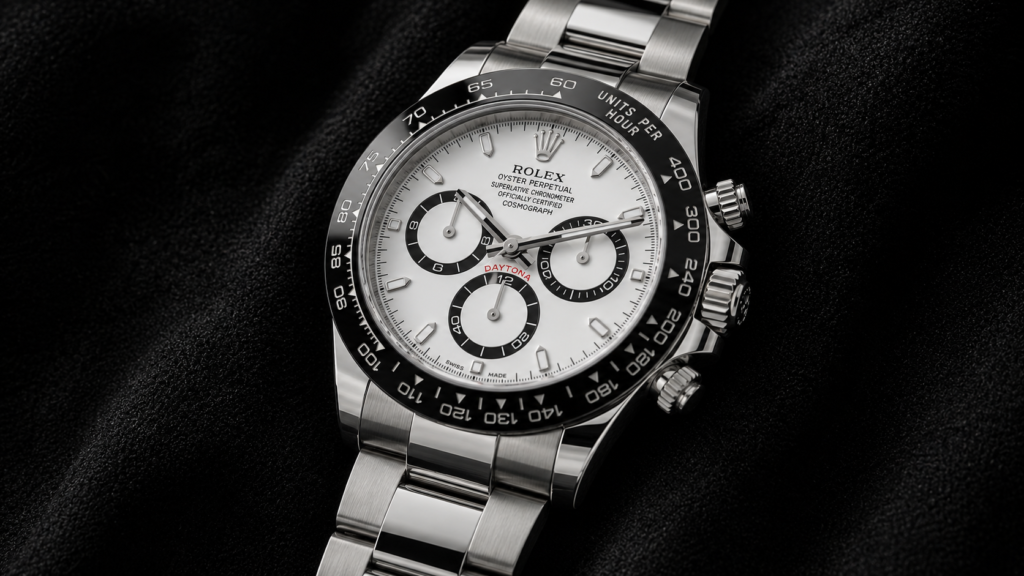
The Submariner, Daytona, and GMT-Master II combine the highest secondary market liquidity in the category with the most predictable retail price pass-through. The Submariner 124060 at current retail of £8,100 has a five-year secondary market appreciation story that substantially outpaces cumulative UK CPI over the same period. For buyers with access to retail pricing, the effective inflation-adjusted return is the nominal appreciation minus the inflation rate, which on the 124060 remains positive even net of transaction costs. Pre-owned examples are available here for buyers without authorised dealer access.
Patek Philippe across collections.
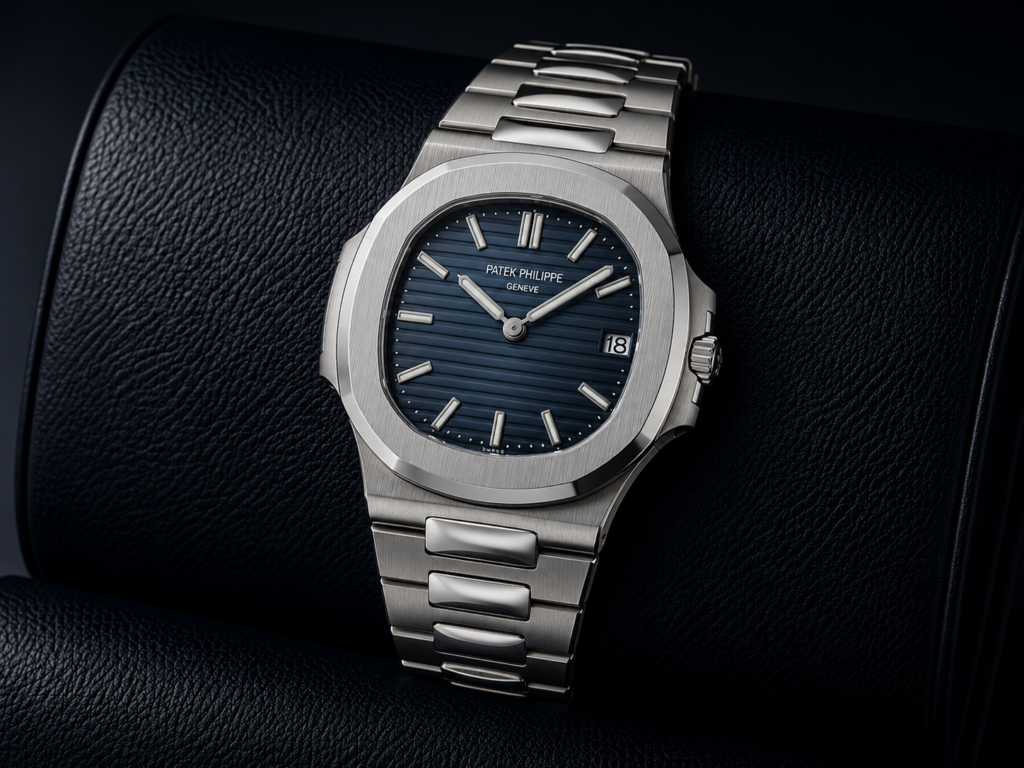
Patek’s institutional brand depth and controlled production (approximately 70,000 watches annually) mean that both retail and secondary market prices are structurally insulated from inflation better than the broader Swiss watch market. The Calatrava and Nautilus collections have each demonstrated retail-to-secondary premiums that persist through inflationary cycles. For reference-level pricing on both, Chrono24 provides the most comprehensive live price comps.
Gold references as a dual hedge.
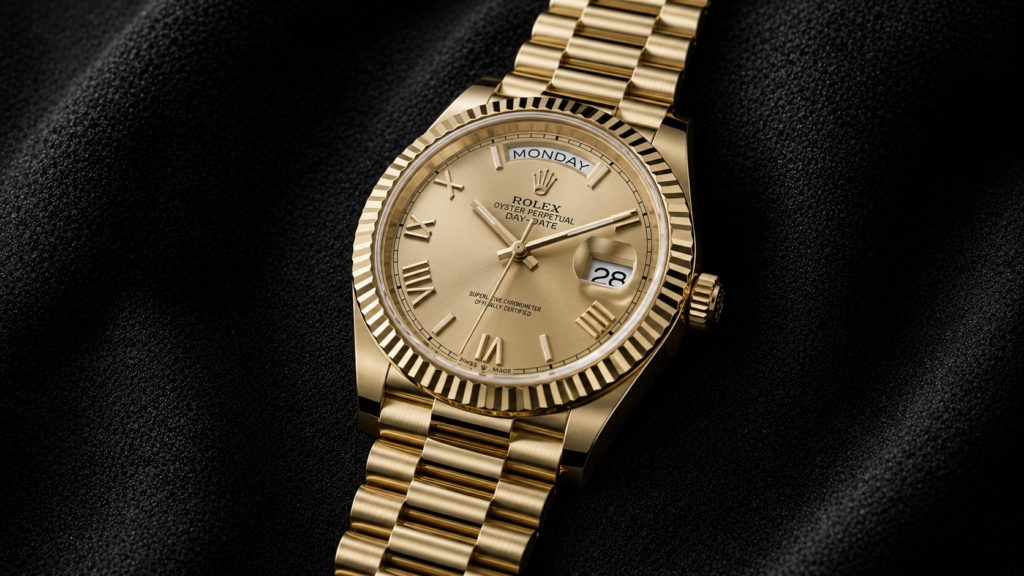
Yellow gold, rose gold, and white gold Rolex and Patek references function simultaneously as a watch investment and a precious metal allocation. The Day-Date 40 in yellow gold (approximately £35,000 to £37,000 retail) carries roughly 75% of its value in gold content at prevailing prices, providing a bullion floor under the investment. When gold prices rise, as they did 27% in 2024, gold references appreciate independently of collector demand. This dual-hedge property makes precious metal references particularly attractive in sustained inflationary environments. For the detailed Rolex performance analysis underlying these observations, see Rolex as a Store of Value: A Data-Driven Analysis.
Which Watches Underperform During Inflation
The distribution of watch performance during inflation is highly skewed. The watches that outperform make the category look attractive. The watches that underperform are the majority by count, and understanding them is as important as identifying the winners.
Fashion brand watches. Watches from fashion houses carry brand premium without hard asset content. In an inflationary environment, consumer discretionary spending contracts around genuine luxury while fashion-adjacent products are repriced downward. A fashion-brand watch at £2,000 to £5,000 that depreciated 50% in normal market conditions will depreciate further under inflationary pressure, as the buyer pool for overpriced fashion products is the first to contract.
Entry-level mechanical watches without secondary market depth. A watch that cannot be sold within sixty days at a transparent price is not an inflation hedge; it is an illiquid asset denominated in depreciating currency. Entry-level Swiss mechanical watches from mid-tier brands, however well-made, lack the brand depth and secondary market infrastructure to reprice with inflation.
Watches that inflate in price without inflating in value. The 2020 to 2022 period produced a category of watches that appreciated on hype rather than fundamentals: limited-edition collaborations, newly launched collections from brands without collector track records, and “grail” references that had never previously commanded premiums. These watches absorbed speculative capital during the inflationary surge and corrected sharply when real rates turned positive. Identifying these requires the same fundamental analysis applied to any speculative asset: if the price is running ahead of the intrinsic value and the exit multiple is not supported by historical comparables, the asset is not an inflation hedge. It is a momentum trade.
The Macro Framework: Applying PE Thinking
The 2022 to 2024 watch market correction is the most useful recent case study in applying macro analysis to watch portfolios, and a PE framework would have predicted it with reasonable precision.
The Bank of England raised rates from 0.1% in December 2021 to 5.25% in August 2023, in response to CPI inflation peaking at 11.1% in October 2022. The mechanism through which rate rises affect the watch market operates on two channels. First, the opportunity cost of holding illiquid assets rises as risk-free rates increase: a watch delivering 6% per annum competes less favourably against a 5.25% Bank Rate than against 0.1%. Second, discretionary luxury spending contracts when mortgage costs rise and consumer confidence falls, reducing the buyer pool for secondary market watches.
The Rolex secondary market peaked in April 2022 and began correcting as rate rise expectations hardened. By November 2023, the Bloomberg Subdial Watch Index marked Rolex at £26,592, down 32.3% in the last 24 months, with some pre-owned Rolex watches down 42% compared to their highest point in April 2022. For any PE investor who had tracked the secondary-to-retail premium and compared it to prior cycle peaks, the correction was not a surprise. The Nautilus 5711 at $200,000 (5.7 times its $35,000 retail price) in a zero-rate environment was a straightforward overvaluation on a DCF basis: strip out the speculative premium and the intrinsic value at any normalised discount rate was materially lower.
The rate-cut cycle that began in late 2024 has provided partial support for the secondary market recovery. Rate sensitivity is now the primary macro variable to monitor in the watch market: further cuts support asset prices broadly, including watches; any re-acceleration in inflation that delays cuts creates headwinds for discretionary alternatives. The framework for integrating these variables into a watch portfolio allocation is covered in detail at How to Analyse a Watch Like a Private Equity Deal and Watches as Alternative Assets in 2025: The Complete Investment Guide.
Practical Implications for Watch Buyers in 2026
UK CPI was 3.3% in March 2026, up from 3.0% in February, with core inflation at 3.1%. Services inflation remains elevated at 4.5%. The Bank of England stated in March 2026 that CPI is likely to be between 3% and 3.5% in the second and third quarters of 2026, due to higher energy prices. This is not a high-inflation environment by 2022 standards, but it is a persistently above-target environment that continues to erode the real value of cash holdings.
The implications for watch buyers in this context are specific.
Buy now rather than later for Rolex steel sport references. Analysts now speculate that 2026 adjustments could be influenced by external factors, with new Swiss watch tariffs looming, and some foresee another 10% to 15% bump if costs are passed on. If retail prices rise 10% in January 2027, buyers who acquired in 2026 at current retail have already outperformed CPI by the retail price increase alone, before any secondary market appreciation.
Prioritise gold references if inflation proves stickier than expected. The dual-hedge property of gold watch references (precious metal floor plus collectible premium) outperforms steel references in sustained inflationary environments. The Day-Date and gold Submariner references will absorb any further gold price appreciation into their secondary market pricing.
Avoid timing the market. The watch buyers who attempted to sell at the April 2022 peak and re-enter at the 2024 trough faced execution risk, transaction costs, and the loss of the use value of the watch during the holding period. Time in the market, for quality references bought at or near retail, has consistently outperformed market-timing attempts in every documented watch market cycle.
Proper asset maintenance applies regardless of macro conditions. A watch that is unworn for extended periods requires service more frequently, as lubricants settle and mechanical components require running-in. A quality watch winder maintains automatic movements in optimal mechanical condition between wears and reduces long-term service costs; a reliable option is available here. For a £10,000 to £50,000 asset, mechanical preservation is part of the asset management discipline.
For pre-owned acquisition in the current environment, Watchfinder & Co. offers the most transparent pricing and fully authenticated inventory across Rolex, Patek Philippe, and AP references, with market pricing that reflects current secondary market levels rather than 2022 peak valuations.
Conclusion: The Inflation-Proof Wrist
The data from 2020 to 2026 validates the thesis that investment-grade luxury watches function as effective inflation hedges, and the structural reasons for that performance have not changed. Controlled supply, hard asset content, global demand in depreciating currency environments, and a retail price pass-through mechanism that tracks input cost inflation: these are the foundations of the hedge, and they remain intact in 2026.
The watches that deliver inflation-beating returns are specific and consistent: Rolex sport references in steel, Patek Philippe across collections, and gold references as a dual precious metal and collectible allocation. The watches that do not deliver this are equally consistent and equally predictable. The distinction is not complicated. It requires only the analytical discipline to apply a fundamental valuation framework to an asset class that most participants still approach as a consumer market.
In an environment where CPI remains above 3% and the Bank of England is navigating energy-driven inflation with limited policy headroom, the case for holding a measured position in investment-grade watches as part of a broader alternatives allocation has rarely been clearer.
DialAndYield.com analyses luxury watches as alternative assets for finance professionals. All prices in GBP are indicative as of Q2 2026. Macroeconomic data sourced from the ONS, Bank of England, and House of Commons Library. Secondary market data sourced from WatchCharts, Chrono24, and Bloomberg Subdial Watch Index. Nothing in this article constitutes financial advice.