Royal Pop: The Swatch x Audemars Piguet Collaboration. The Numbers Behind the Chaos
This article was written on May 17, 2026, the day after launch. The data is real-time.
At 3 a.m. on May 16, crowds had already gathered at the Dubai Mall. By 8 a.m. in London, people had forced past security at Battersea Power Station. By mid-morning in Miami, 3,000 people flooded the Aventura Mall, causing a stampede that shut the launch entirely. Police deployed pepper spray at the Roosevelt Field Mall in Long Island. Swatch boutiques in Mumbai, Bengaluru, Delhi, Paris, and Glasgow did not open at all, with managers using loudspeakers to disperse crowds that had been queuing overnight. On StockX, resale listings appeared the day before the official launch. By mid-afternoon, individual Royal Pop pocket watches were listed at $1,200 to $8,000+ against a retail price of £335 to £350. Swatch issued a statement requesting buyers to “not rush to our stores in large numbers.” For a £350 pocket watch. That is the opening scene. The investment question comes next.
What Is Royal Pop?
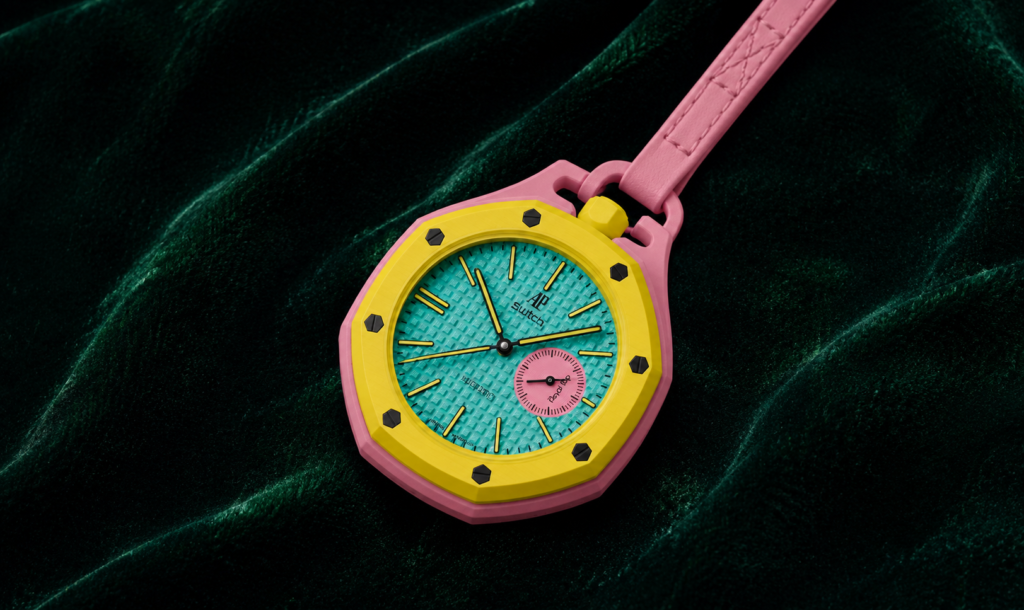
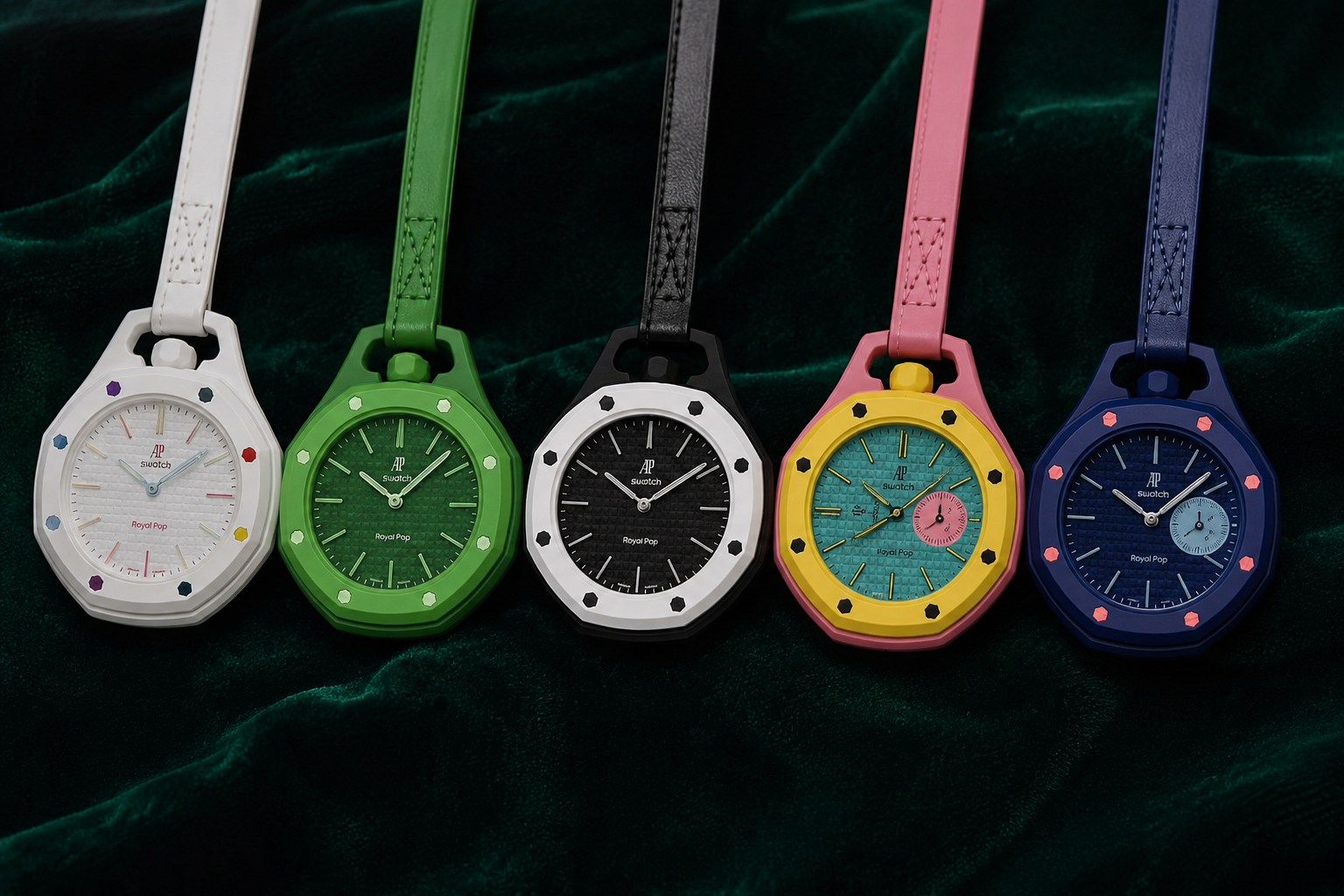
Royal Pop is a collection of eight Bioceramic pocket watches, the result of the first collaboration between the Swatch Group and an independent luxury watchmaker in the modern era. Audemars Piguet has never before licensed the Royal Oak silhouette outside its own factory walls. On May 16, 2026, that changed.
The collection launches in two case configurations. The Lépine is an open-face pocket watch with the winding crown at 12 o’clock and a two-hand display (hours and minutes). The Savonnette is a hunter-case format with a hinged cover and the crown at 3 o’clock, adding a small seconds subdial. Both case styles measure 40mm across and 8.4mm thin, wearing between the 39mm Royal Oak Jumbo and the 41mm 15500ST in footprint. The case is Bioceramic, Swatch’s ceramic-filled polyamide 11 derived from renewable castor oil, the same material used in every MoonSwatch and Blancpain Scuba Fifty Fathoms. Water resistance is 20 metres.
The movement is a hand-wound version of the SISTEM51, developed specifically for Royal Pop and featuring Audemars Piguet’s Nivachron anti-magnetic balance spring, a detail the two brands have collaborated on since it first appeared in AP’s movements. Power reserve exceeds 90 hours. The mainspring barrel is visible through the case back and doubles as a power reserve indicator: grey coils mean wind it, gold means it is fully powered. Eight unique patents cover the case construction.
The eight colourways reference the eight sides of the Royal Oak bezel, each in a different language: Otto Rosso (Italian, red), Huit Blanc (French, white), Green Eight (English, green), Blaue Acht (German, blue), Ocho Negro (Spanish, black), Orenji Hachi (Japanese, orange), Làn Ba (Chinese, blue), Otg Roz (Romansh, rose). Retail price: £335 for Lépine models, £350 for Savonnette models ($400 and $420 respectively). One per customer, per store, per day. In-store only, no online sales at launch. UK has 13 participating locations. 100% of Audemars Piguet’s proceeds fund watchmaking apprenticeships and rare-skill preservation initiatives.
The Launch: What Actually Happened
The MoonSwatch launch in March 2022 saw the Carnaby Street store shut down by Met Police within thirty minutes after only ten customers had been served. The Royal Pop launch was objectively worse.
In Tokyo’s Ginza, overnight queues hit 300 people before dawn. Shibuya and Harajuku saw 150 to 180 people each. In New York, queues at the SoHo and Times Square locations reportedly began forming days before launch. In Miami, 3,000 people flooded the Aventura Mall, causing a full stampede; the launch was cancelled. In London, the Battersea Power Station store was described by MyLondon as “hostile with barging and heckling.” Multiple UK stores including Westfield London and Glasgow did not open at the scheduled 9 a.m. time; managers used loudspeakers to inform crowds that the stores could not safely open. In Paris, crowds who had queued through the night rushed stores at opening, causing physical spillovers that forced boutiques across the country to remain closed under police instruction. In Dubai, the situation at the Dubai Mall became sufficiently disorderly that the launch was cancelled entirely. In Mumbai, scenes at Palladium Mall escalated to the point where the store chose not to open. In India broadly, viral videos showing pushing, shouting, and crowd-control failures were circulating within hours of launch.
At Roosevelt Field Mall in Long Island, New York, police deployed pepper spray to manage the situation. Swatch issued an official statement: “To ensure the safety of both our customers and our staff in Swatch stores, we kindly ask you not to rush to our stores in large numbers to acquire this product.” The company confirmed that queues of more than 50 people may not be accepted and that sales could temporarily be paused. It also confirmed that the Royal Pop collection would remain available for several months, a detail that reveals something important about the investment case.
On StockX, over 100 watches had sold by 11 a.m. on May 15, a full day before the official retail release. By launch day afternoon, eBay listings ranged from $1,200 to £16,000 ($21,000) for complete sets. The average resale price for individual watches settled around $905, more than double retail. One buyer paid $8,410 for the complete set. The most sought-after colourways on the secondary market were the Savonnette Làn Ba, Huit Blanc, and Ocho Negro.
The MoonSwatch Precedent
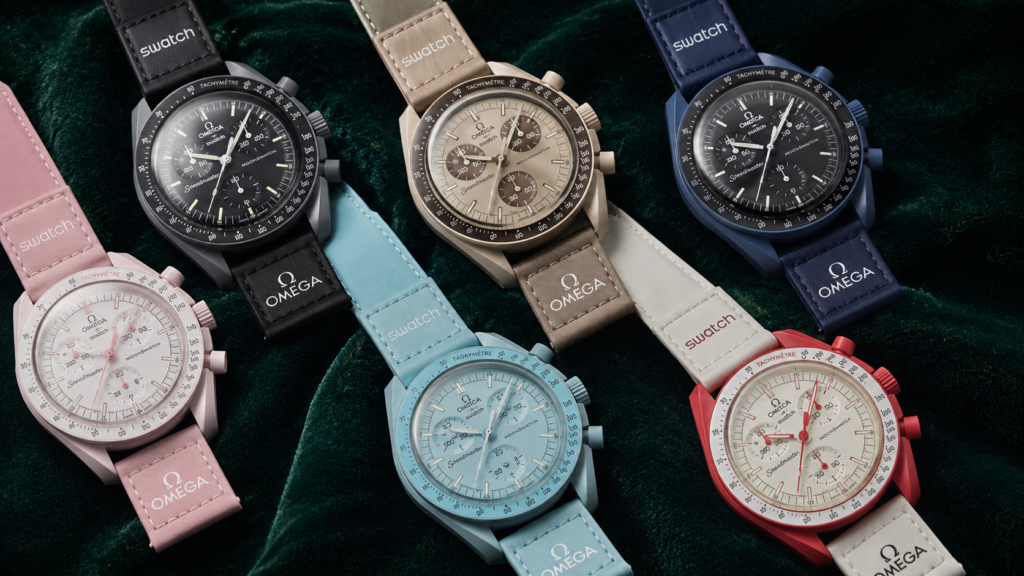
The MoonSwatch launched in March 2022 at CHF 250 (approximately £215 at that time). On the day of launch, secondary market pricing on StockX and eBay hit 5x to 20x retail, with certain colourways trading above $1,500 against a $260 retail price. The Mission to Moonshine Gold limited edition, released in 2023, sold out similarly and briefly commanded even steeper premiums.
Where does the MoonSwatch trade in May 2026? According to WatchCharts, MoonSwatch watches cost around $300 on average, with prices ranging from approximately $200 to $500 depending on the model. Some individual models have declined 35% to 36% over the past year. The most popular reference, the SO33M100, has an extreme risk score of 88/100 on the WatchCharts platform. The MoonSwatch SO33G100 (Mission on Earth) is down 35.9% year-on-year. The entire WatchCharts Swatch index has declined approximately 4% over the same period.
The lesson is precise and uncomfortable for anyone holding a MoonSwatch bought at secondary market premium in 2022: the flip window was measured in weeks, not months. Buyers who acquired at retail on launch day and sold within thirty days captured meaningful returns. Buyers who held expecting sustained appreciation are now sitting below their entry cost. The MoonSwatch did not become a store of value. It became a cultural artefact that trades near or below retail four years after launch.
Current Resale Prices: The Real Numbers
As of May 17, 2026, one day after launch, the data is as follows. Average individual Royal Pop resale on StockX and eBay: approximately $905, representing a 126% premium to the $400 retail price and a 115% premium to the £335 UK retail. The complete set of eight watches and lanyards sold for $8,410. Lanyards are averaging $245 independently. The Savonnette Làn Ba (Chinese blue, two-tone), Huit Blanc (white), and Ocho Negro (black) command the highest individual premiums.
Listings on Chrono24 and eBay range from approximately £800 for individual Lépine references in common colourways to £2,500-plus for full-set Savonnette examples in the most sought-after colourways. The premium is real. The question is whether it is durable.
Comparing to MoonSwatch trajectory: the MoonSwatch secondary premium peaked within the first week and began compressing within thirty days of launch as additional inventory reached stores. By month three, secondary prices had normalised to 1.5x to 2x retail for most references. By year two, they were trading at or below retail. The Royal Pop has one potentially differentiating factor: the pocket watch format and lanyard system make this a genuinely different object from the MoonSwatch, with a higher barrier to impulse purchase (you have to want a pocket watch, not a wristwatch). Whether that structural differentiation sustains collector demand beyond the initial frenzy is the open question.
The Investment Case: Honest Analysis
Applying the PE framework from the DialAndYield analytical lens (for the full methodology, see How to Analyse a Watch Like a Private Equity Deal), the Royal Pop investment case resolves as follows.
Entry price: £335 to £350 at retail. Current grey market: approximately £700 to £2,500 depending on reference.
Current secondary market multiple: 2.1x to 7x retail depending on colourway and format, with the weighted average around 2.3x.
The flip case: If you are holding a Royal Pop acquired at retail on May 16, the window to exit at maximum premium is now. The average 2.3x secondary multiple represents an 130% gross return on a £335 investment. That is a £430 gain per watch before platform fees and taxes. This is real money for a one-day hold. Exit via eBay Royal Pop listings or Chrono24 within the next two to four weeks for the best execution.
The hold case: The MoonSwatch data argues clearly against holding for long-term appreciation. The WatchCharts Swatch MoonSwatch index has declined significantly since its 2022 peak. Most MoonSwatch references now trade below retail on the secondary market. The Royal Pop has a small-batch, hand-wound movement (more interesting than the MoonSwatch’s automatic SISTEM51), a unique pocket watch format, and the first-ever Royal Oak design DNA outside Le Brassus. These are better fundamentals. But Swatch has confirmed the collection will be available for “several months,” which is the clearest possible signal that supply will eventually meet demand and the premium will compress.
The Bioceramic depreciation pattern: Bioceramic is a durable material that does not scratch like metal or degrade like rubber. The physical asset will not deteriorate meaningfully. But the premium is not driven by material quality; it is driven by scarcity perception, and that scarcity perception is temporary by Swatch’s own confirmation.
Who actually profits: Swatch Group and Audemars Piguet, categorically. They sell at retail, they generate the chaos that creates free global press coverage worth hundreds of millions in marketing value, and AP directs its proceeds to watchmaking preservation, generating additional brand equity. The buyer who acquires at retail and flips within thirty days earns a modest but real return. The buyer who pays £2,000 on the grey market today expecting further appreciation is the least well-positioned participant in this transaction.
Verdict: Buy it at retail and flip within thirty days if you can get access. Do not buy at grey market premium as an investment. Compare the opportunity cost: for £2,000 you can acquire a pre-owned Tudor Black Bay 58 at retail with a 15-day median sale time and a verified secondary market track record. Pre-owned AP Royal Oak references are available at prices that represent a genuinely different quality of asset.
What Royal Pop Does for the AP Brand
The relevant precedent is the MoonSwatch’s effect on Omega. In March 2022, many collectors worried that the MoonSwatch would trivialise the Speedmaster. Four years later, the Speedmaster’s secondary market position is unchanged, and the MoonSwatch demonstrably expanded the audience of people who know what a Speedmaster is. The democratisation did not dilute the original; it amplified awareness of it.
The Royal Oak case is more complex, for a specific reason. The Royal Oak is not primarily a technical object in public perception the way the Speedmaster is. It is a status and cultural object. Its value is partially constituted by its exclusivity. A pocket watch in eight candy colours, available for £350 in a shopping mall, does something the MoonSwatch never did: it places the Royal Oak’s visual language in the hands of anyone with £350 and a queue ticket. That is meaningfully different from placing a Bioceramic Speedmaster on the wrists of budget-conscious watch enthusiasts.
The question for AP’s existing collector base is whether the Royal Oak Jumbo at £30,000-plus retains its cultural premium when its design is visible on a lanyard in a Westfield shopping centre. The honest answer is: probably yes, because the materials and craftsmanship of the real Royal Oak are so different from the Bioceramic pocket watch that they cannot be confused by anyone who handles both. But the brand tension is real, and the long-term impact on the Royal Oak’s investment case bears watching. For the full analysis of the Royal Oak as an investment, see Audemars Piguet: Brand Guide and Investment Analysis.
Should You Buy One?
Three clear profiles and an honest recommendation for each.
The flipper. If you can acquire at retail today or within the next week, the flip case is real and the window is narrow. Sell within thirty days, accept platform fees of 10% to 15%, and pocket the difference. The data from the MoonSwatch confirms that four-week holders outperformed twelve-month holders by a substantial margin. Retail access in the UK through the 13 participating Swatch boutiques is the entry requirement. Secondary market Royal Pop listings for buyers tracking resale prices are on eBay here. Buying at grey market and expecting to flip at a higher premium is the highest-risk position in this trade.
The collector. If you are drawn to the Royal Pop as a design object (and it is genuinely interesting: a hand-wound mechanical pocket watch at £350 with AP’s balance spring and an 8-patent case construction is remarkable for the price), buy it at retail for the object itself. Choose the colourway you actually want, not the one with the highest secondary premium. Wear it, display it, use it. It will not appreciate. It will likely depreciate to retail or below within a year, as the MoonSwatch precedent makes clear.
The fashion buyer. Buy it at retail. Do not buy it at grey market premium. The watch is genuinely well-designed and culturally significant in 2026. Paying £2,000 for something available at £350 from a Swatch boutique if you are patient is not a fashion decision. It is an impatience premium.
For those who want the Royal Oak experience as a genuine investment rather than a collaboration piece, pre-owned Audemars Piguet Royal Oak references represent a structurally different allocation, and current post-correction pricing is more attractive than it has been since 2019. Those listings are available here for comparison.
Conclusion: Buy It to Wear It
The Royal Pop is a cultural object, not a financial instrument. The scenes at Dubai Mall, Battersea Power Station, and Roosevelt Field are not evidence of investment-grade scarcity; they are evidence of engineered spectacle that Swatch has now perfected across three collaborations. The MoonSwatch proved that the flip window exists, is real, and is very short. Any buyer with retail access today who exits within thirty days will make a return. Any buyer who pays grey market premium today and expects the secondary market to carry them further is reading the MoonSwatch trajectory backwards.
Buy it at retail if you can. Wear it, sell it in a month, or keep it as the cultural artefact it genuinely is. Just do not mistake the queue for a moat.
DialAndYield.com analyses luxury watches as alternative assets for finance professionals. All prices in GBP and USD are as of May 17, 2026. Secondary market data sourced from StockX, eBay, WatchCharts, and Chrono24. Nothing in this article constitutes financial advice.