Royal Pop: Where Are Prices Now? The 3-week Investment Verdict
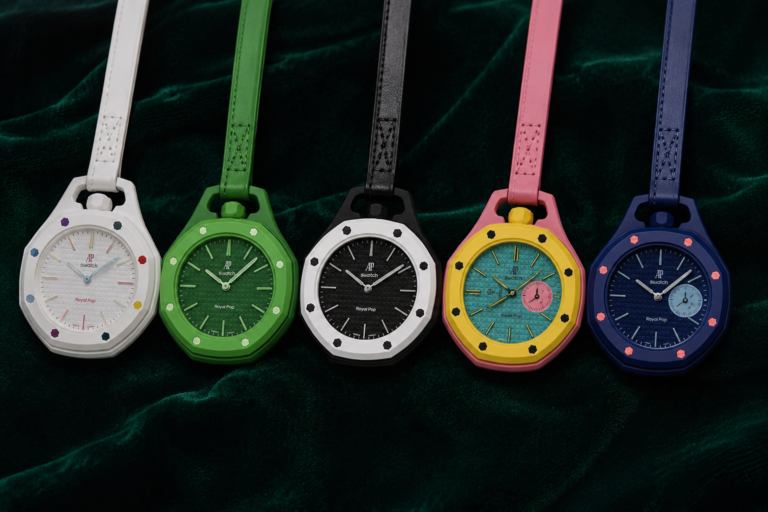
On May 16, 2026, the Swatch x Audemars Piguet Royal Pop launched globally to pepper spray in Long Island, cancelled events in Dubai and Mumbai, and resale listings hitting five figures before most buyers had left the queue. We published our analysis the following day, when secondary market prices were averaging $905 per piece and the data was moving by the hour. Three weeks later, the picture is materially different. This is the update, using the most current data available as of June 7, 2026.
Data sourcing note: The most current aggregated data comes from WatchCharts as of June 2026, showing average Royal Pop secondary market pricing at approximately $1,000 per piece. WatchPro’s market queries tracked prices through May 17 to May 26. CNBC published an analysis on June 2, 2026 drawing on WatchCharts’ AP brand index data. Where specific date ranges apply to data points, they are stated clearly.
What Has Happened to Royal Pop Prices?
The short version: the peak was over within 48 hours. The longer version is more instructive.
On launch day, the Làn Ba blue Savonnette hit $6,547 on eBay at the moment Swatch paused sales. Full eight-piece sets averaged $9,476 on StockX, a 192% premium over retail. Per-piece StockX averages cleared $1,351, a 222% markup.
The collapse began almost immediately. WatchPro’s tracking of eBay and Chrono24 averages showed prices softening 6 to 7% within the first 24 hours, with the trajectory accelerating. By day two, the Huit Blanc, which had cleared €2,022 on Sunday, was falling to roughly $1,295 in current listings. The Làn Ba, which peaked at €4,310, dropped to around €1,431, a slide of more than 66% on the most coveted reference in the lineup.
By day four, StockX had cleared 1,279 sales and every model had dropped overnight, between -5.8% and -19.2%.
In the period between May 17 and May 26, a hierarchy stabilised. The Huit Blanc (rainbow on white) emerged as the strongest performer, trading at $1,950 to $2,100 on eBay and StockX, five times retail. The lowest-priced piece was the Làn Ba at approximately $1,400. The catalyst for the most dramatic early compression was Swatch’s own intervention. Swatch posted on LinkedIn reminding buyers that “the Royal Pop Collection is not a limited edition,” a clarification that accelerated the resale decline.
As of June 2026, WatchCharts shows average Royal Pop pricing at approximately $1,000 per piece, with the most popular reference (the Ocho Negro, SSX03W101N) at a market value of $1,104. This represents roughly 2.5x the $400 retail price, down from the 3.4x average at our May 17 publication date and dramatically below the day-one peak multiples of 10x to 16x for the most coveted colourways.
Current Chrono24 listings show asking prices still skewed above $1,000 on premium colourways, but WatchPro’s analysis noted that Chrono24 listings “are still heavily distorted by speculative dealer pricing” and that eBay sold listings are the cleaner signal. Current eBay Royal Pop listings reflect the compressed but still-above-retail reality as of this writing.
The MoonSwatch Comparison: How Accurate Was Our Prediction?
Our May 17 analysis stated clearly: “The MoonSwatch proved that the flip window exists, is real, and is very short.” The Royal Pop data has validated this with precision.
According to WatchCharts and Morgan Stanley Research, MoonSwatch secondary market prices dropped nearly 18% year over year in Q1 2024, and another 5.5% in the following three months. A brand new MoonSwatch Mission to the Moon was selling on eBay for under £290, with some references trading under £200 by mid-2025.
Where is the MoonSwatch today? According to WatchCharts’ June 2026 data, MoonSwatch watches cost around $300 on average, ranging from $200 to $500 depending on the model. The most popular reference (SO33B700) has an estimated market value of $341. The MoonSwatch launched at $260 retail in March 2022. Four years later it trades near retail or modestly above, with significant downward pressure on older references.
The Royal Pop is following the same curve, but faster. The MoonSwatch took approximately 18 months to normalise from peak to near-retail. The Royal Pop appears to be compressing in weeks, not months. The key difference: Swatch’s public statement that the Royal Pop is “not a limited edition” and will “remain available for months and months” removed the scarcity premise on day one, collapsing the timeline for premium compression dramatically.
At the equivalent three-week mark post-MoonSwatch launch in 2022, secondary pricing was still holding at 4x to 6x retail. Royal Pop at the same interval is at approximately 2.5x. The trajectory divergence is meaningful and directional.
Who Made Money and Who Lost It
Three buyer profiles, with honest arithmetic.
The retail flipper who sold within the first week. If you acquired at retail (£335 to £350, approximately $400 to $420) and sold in the 72-hour window at or near launch day averages of $1,351 on StockX, your gross return was approximately 225% on a $400 investment, or roughly £750 to £800 per watch before platform fees. StockX charges approximately 9.5% seller fee and 3% processing, reducing net proceeds to approximately $1,150 per watch. Net profit: approximately £580 to £620 per watch, achieved in under a week. This is a genuinely excellent one-week return. Our prediction was correct that this window existed and was narrow.
The retail buyer who held to today (June 7). You acquired at £335 to £350 retail. Your watch is now valued at approximately $1,000 to $1,100 (approximately £790 to £870) depending on colourway, based on WatchCharts’ June 2026 data. You are still sitting on a paper gain of approximately 130% to 150% above your entry cost, but you have lost approximately 40% of the peak value that was briefly available. The question is whether $1,000 is a floor or a waypoint. Given Swatch’s stated multi-month availability, the MoonSwatch precedent, and the ongoing supply restocking, the MoonSwatch trajectory suggests this level does not hold. A retail buyer who bought to wear it has no decision to make. A retail buyer who is considering exit should note that the directional pressure is downward and the longer you wait, the closer to retail the price travels.
The grey market buyer who paid $1,351 (launch day StockX average). At current prices of approximately $1,000, you are down approximately 26% from your entry. The watch is still above its retail price of $400, but you did not pay retail. You paid $1,351 for an asset worth approximately $1,000 that retails at $400. Exit now crystallises a 26% loss. Holding has no credible catalyst for recovery given Swatch’s confirmed non-limited status and ongoing production. This is the position our May 17 article explicitly warned against.
The grey market buyer who paid £1,000-plus in the UK. Several listings at launch were clearing £700 to £1,200 in Sterling on eBay UK. At current Sterling equivalent prices (approximately £790 to £870), buyers at the lower end of that range are approximately flat; buyers at £1,000-plus are underwater. Exit now.
Has Availability Changed?
The retail availability story is the most important variable for secondary market direction. Swatch Group CEO Nick Hayek confirmed the collection “will remain available for months and months,” but restocking has been sporadic and extremely limited. The Swatch boutique network is restocking unevenly: some locations have received additional stock, others remain empty. The in-store-only, one-per-customer policy remains in place globally. There is no indication of online sales being introduced.
This creates an unusual secondary market dynamic: the watches are technically available at retail but not consistently accessible without boutique queuing. Secondary demand therefore persists above retail because of the friction involved in retail acquisition, even though the scarcity premise has been publicly refuted by Swatch. As restocking becomes more consistent across the next four to eight weeks, this friction premium will continue to compress.
The immediate queue frenzy is over. No major Western city is reporting anything like the May 16 scenes. Battersea Power Station, New Bond Street, and Carnaby Street are operating normally. The watch is culturally interesting but no longer an emergency.
The Updated Investment Verdict
Our original thesis, stated on May 17: “The flip window is real and narrow. Exit within thirty days.” That thesis has been validated by the data. The window was real; the buyers who acted in the first seventy-two hours captured meaningful returns. Buyers who held expecting the Swatch collaboration premium to persist on a publicly confirmed non-limited edition were reading the MoonSwatch trajectory in the wrong direction.
The question as of today, June 7, is whether any investment case persists for the Royal Pop.
At current secondary market pricing of approximately $1,000 (£790 to £870), the watch trades at roughly 2.5x retail. This premium is supported by boutique friction (you still cannot easily buy one online) and by genuine cultural demand from buyers who missed the retail queue. This support will diminish as Swatch restocks over the coming months.
The hold case at current secondary market prices ($1,000) is weak. There is no mechanism for appreciation back toward the $2,000-plus range that characterised the first week. The only scenario in which holding makes financial sense is if Swatch permanently discontinues the collection, which contradicts every public statement made by both brands. The Royal Pop has no stated end date.
The buy-at-secondary case at current prices is irrational if the motivation is investment. You are paying 2.5x retail for a watch that Swatch has confirmed will be available at retail for months. The MoonSwatch, which launched under similar dynamics, now trades near its original retail price. The rational expectation for the Royal Pop is the same endpoint.
For broader context on the analytical framework behind this assessment, see our original analysis at Royal Pop: The Swatch x Audemars Piguet Collaboration: Hype, Investment or Both? and How to Analyse a Watch Like a Private Equity Deal.
One important finding our May 17 article correctly anticipated: the Royal Pop has not damaged the AP Royal Oak investment case. According to CNBC, citing WatchCharts data as of early June 2026, AP’s secondary prices held steady on the secondary market following the Royal Pop launch. In Q1 2026, AP’s secondary prices were up 2%, compared with 1.7% for Rolex and 3% for Patek. The Royal Oak at £18,000-plus retail and the Royal Pop at £335 are different enough in material, mechanism, and price to occupy entirely different buyer universes. The brand tension we identified exists at the perception level; it has not translated into secondary market damage for pre-owned AP Royal Oak references.
Conclusion: The Queue Has Cleared. Has the Value?
The queue cleared weeks ago. The value is clearing more slowly but in the same direction.
The Royal Pop secondary market has compressed from 10x to 16x retail on launch day to approximately 2.5x today, and the direction is downward with no structural mechanism for reversal. The retail buyers who sold in the first week made real money. The retail buyers who held have a paper gain that is eroding. The grey market buyers who paid $1,000-plus are underwater or breaking even.
The verdict at current prices is unambiguous: if you hold a Royal Pop acquired at retail, the time to exit is now, not later. If you are considering buying at current secondary market prices of approximately $1,000, the MoonSwatch precedent says clearly what you are likely buying into. The watch is a cultural object, a clever piece of design, and a genuinely interesting mechanical pocket watch at £335. At $1,000 on the secondary market, it is none of those things. It is a deteriorating premium on a non-limited commodity.
Buy it to wear it. Sell it if you bought it to flip. Do not buy it now as an investment.
DialAndYield.com analyses luxury watches as alternative assets for finance professionals. All prices in GBP and USD are current as of June 7, 2026. Secondary market data sourced from WatchCharts (June 2026), WatchPro analysis (May 17 to May 26, 2026), StockX, Chrono24, and CNBC (June 2, 2026). Nothing in this article constitutes financial advice.