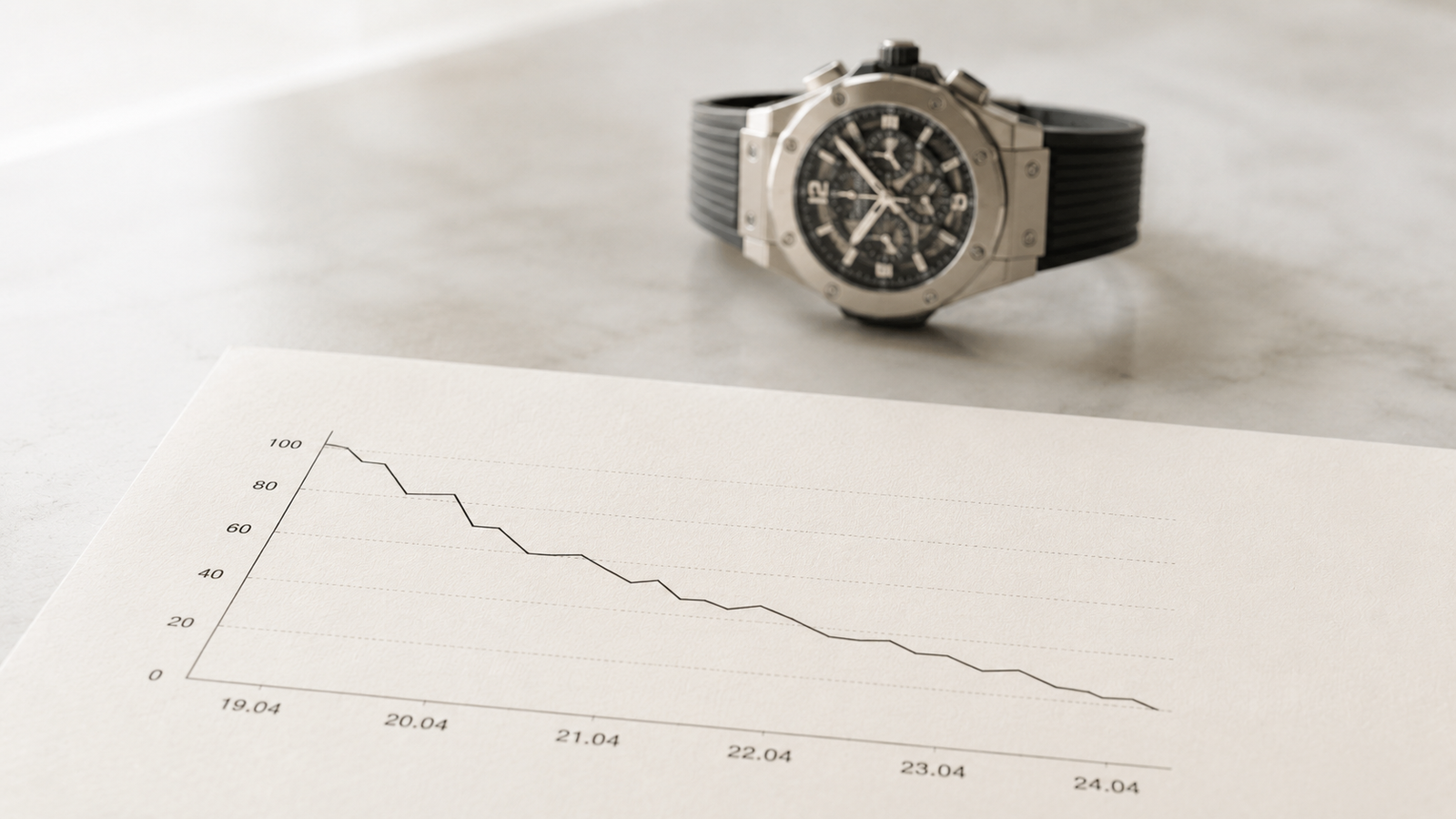
The Worst Watch Investments of the Last Decade: A Data-Driven Analysis
The watch investment conversation is dominated by winners. Rolex appreciation curves, Patek Philippe secondary market premiums, AP Royal Oak returns. The data points that circulate in finance circles and watch publications are almost uniformly positive, drawn from the upper tail of performance distribution. Nobody talks about the watches that destroyed capital. This article does.
The underperforming majority is the more instructive dataset. Understanding which watches lost money, how much they lost, and why they lost it is the most direct path to protecting capital in the category. The losses are not random. They are structural, predictable, and avoidable if the analytical framework is applied before purchase rather than after.
How We Define a Bad Watch Investment
A bad watch investment is not the same as a bad watch. The Hublot Big Bang is a technically competent piece with a genuine following. The IWC Portofino is a well-designed, well-executed dress watch from a respected manufacture. The Chopard Happy Sport is a well-made, commercially successful women’s piece. All three are bad investments. The distinction matters because confusing personal enjoyment with investment quality is precisely how capital gets destroyed.
A bad watch investment is defined here by three measurable criteria. First, secondary market pricing below retail over a five-year holding period, adjusted for inflation. Second, poor secondary market liquidity (long sale times, limited buyer depth, wide bid-ask spreads). Third, structural reasons why the pattern of underperformance is unlikely to reverse. The data is sourced from WatchCharts, which maintains five-year secondary market price histories and liquidity metrics for over 25,000 references, and cross-referenced against Chrono24 transaction data.
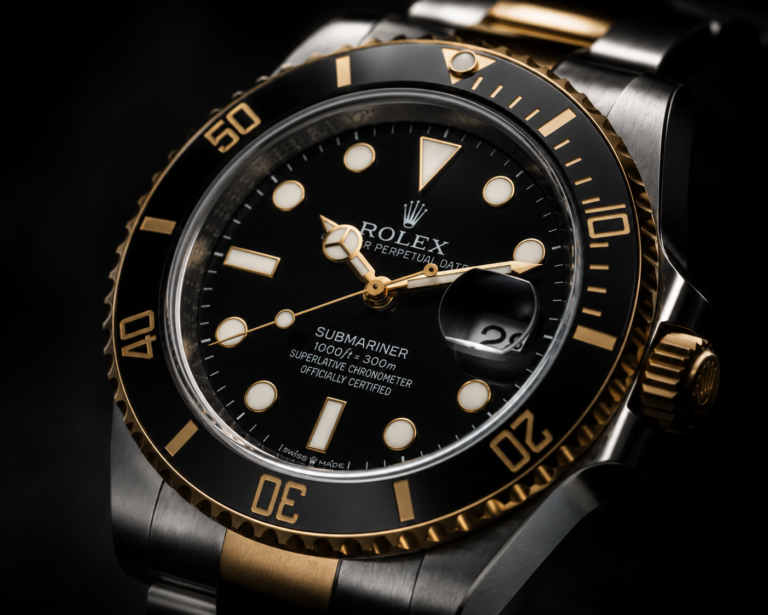
The relevant comparison throughout this article is the Rolex Submariner 124060: retail £8,100, secondary market £10,000 to £10,500 in full-set condition as of Q2 2026, 15-day median sale time, and a five-year appreciation of approximately 23% in nominal terms. Pre-owned Submariner examples illustrate what investment-grade secondary market depth actually looks like in practice. Everything below is measured against this baseline.
The Worst Performing Brands of the Decade
Hublot. The most analytically clear case of marketing-driven value destruction in modern watchmaking. The WatchCharts Hublot brand index has declined approximately 11.7% over the past year alone, and specific Big Bang references have declined 29.7% to 32.3% over five years against an overall market that appreciated over 20% in the same window. The Big Bang steel ceramic (ref. 301.SB.131.RX) is down 32.3% over five years and 15.7% over the past year. The rose gold Big Bang (ref. 301.PX.130.RX) is down 28.4% over five years. Average pre-owned Big Bang values across all configurations sit around $12,000 against retail prices of £15,000 to £25,000 for standard configurations, implying losses of 40% to 60% from retail in normal configurations.
The structural reason is straightforward. Hublot’s commercial model combines high retail price points with aggressive marketing spend, celebrity and sports sponsorship, and frequent limited edition releases. Each of these factors works against investment value. High retail pricing inflates the entry cost without inflating secondary demand. Marketing spend creates awareness without collector scarcity. Frequent limited editions dilute the scarcity premium of any individual reference. The result is a brand where secondary market pricing is structurally lower than retail across nearly all references and where no systematic mechanism exists to reverse that relationship. Hublot’s LVMH ownership since 2008 is commercially rational but removes the independent family ownership structure that constrains supply at Rolex and Patek Philippe.
Jacob and Co. Retail prices range from approximately £50,000 for entry complications to well over £1,000,000 for the Astronomia Tourbillon. Secondary market pricing on most references sits at 50% to 70% below retail. The Astronomia is technically spectacular, visually extraordinary, and mechanically inventive. It is also one of the most reliable capital destroyers in modern watchmaking for buyers who treated it as an investment. The buyer pool is narrow, the authentication complexity is high, and the brand lacks the institutional secondary market infrastructure that Rolex and Patek benefit from. A five-year hold of a Jacob and Co Astronomia reference initiated at retail typically returns approximately 30 to 50 pence in the pound. The watches are worth buying for the experience of owning something extraordinary. They are not investment instruments.
Chopard. Average yearly depreciation of approximately 3.8% per year, with first-year losses averaging 42.8% across the brand. Pre-owned Chopard pricing sits approximately 44.9% below original retail across the portfolio. The L.U.C collection performs better than the brand average (genuine in-house manufacture, respected by collectors), but the Happy Sport and most jewelled lines follow the standard fashion-adjacent depreciation curve. The structural reason: Chopard occupies the jewellery-luxury crossover space, where resale is driven by jewellery market dynamics rather than collector watch market dynamics. Jewellery depreciates more aggressively than watches with established horological content.
The Specific References That Lost the Most
Hublot Big Bang 45mm Steel Ceramic (ref. 301.SB.131.RX):
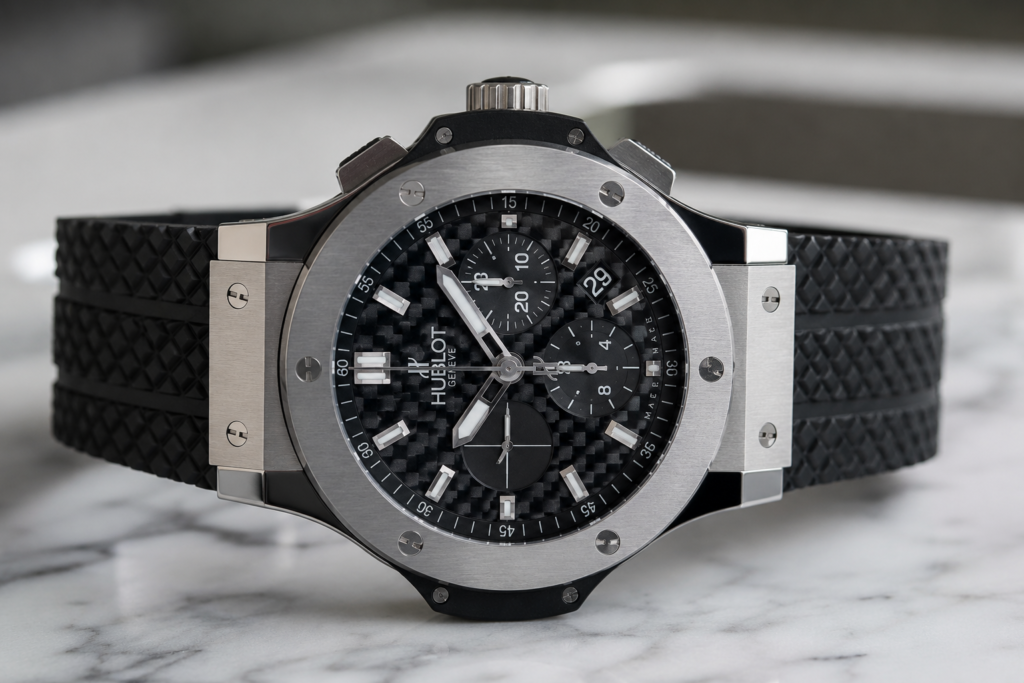
Retail approximately £14,500 to £16,000. Secondary market current value approximately £7,000 to £9,000, representing a 40% to 55% loss from retail. Down 32.3% over five years in secondary market pricing on WatchCharts, with an extreme risk score of 72/100. The reference has now been traded on the secondary market since 2015, providing a statistically reliable depreciation curve: it does not recover.
Chopard Happy Sport (steel, diamond floating dial variants):
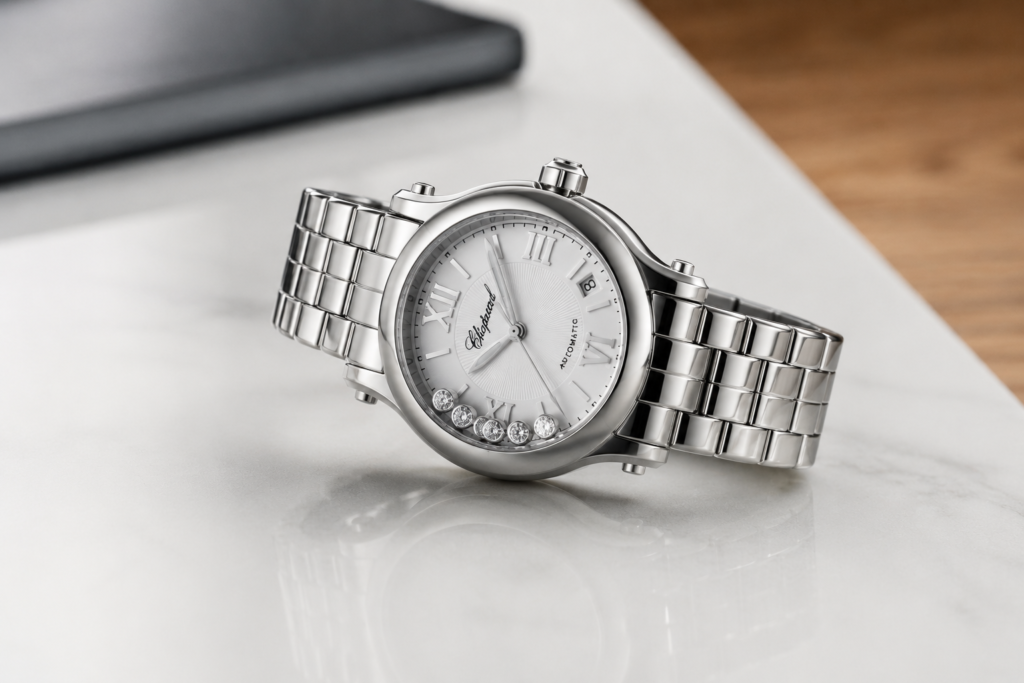
Retail approximately £5,500 to £9,000 depending on configuration. Secondary market pricing typically represents 50% to 60% of retail within two years of purchase. The watch performs well as a worn piece for its intended owner. It performs poorly as an asset because the buyer pool is narrower than for comparable dress watches and the brand’s secondary market infrastructure is materially weaker than Swiss houses with dedicated collector followings.
IWC Portofino (modern stainless steel references):
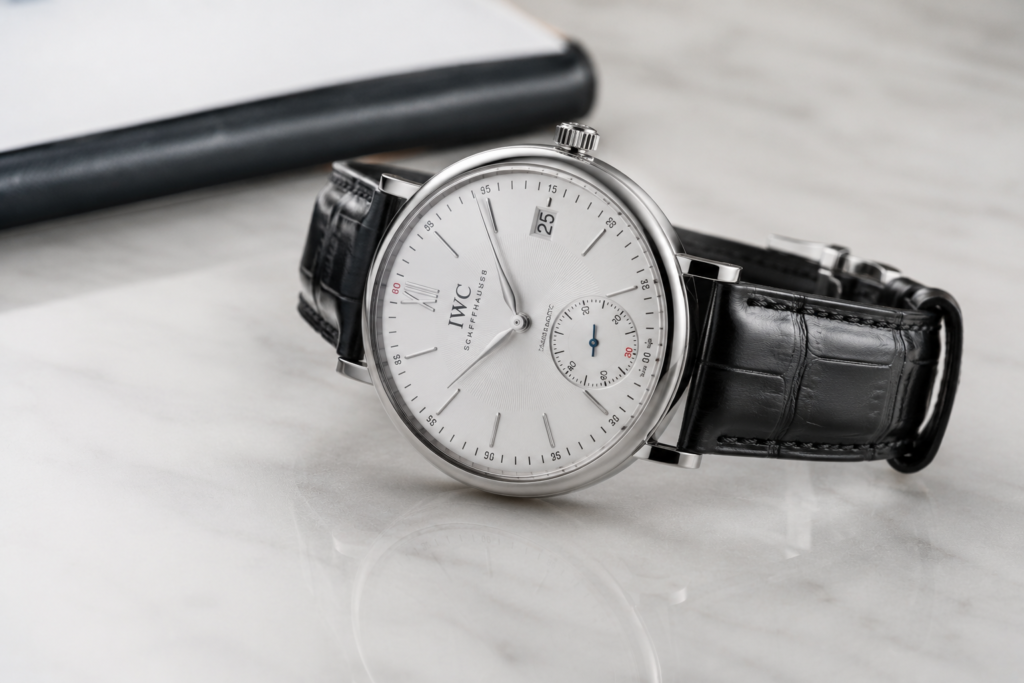
Retail approximately £5,800 to £9,500 depending on case size and complication. Secondary market pricing sits at 60% to 75% of retail, implying a 25% to 40% loss from purchase. IWC broadly depreciates 40.7% in the first year across its portfolio, with the Portofino following the standard industry depreciation curve throughout its first twenty years of life. The IWC Portofino is an excellent watch. It will not reward capital. The brand’s strongest investment reference is the Pilot Mark series, which benefits from aviation heritage and stronger collector demand, but even this category trades below retail. Buy IWC to wear it and enjoy it; the secondary market does not exist in the Portofino’s favour.
Dior VIII (and most fashion brand watches at similar price points):
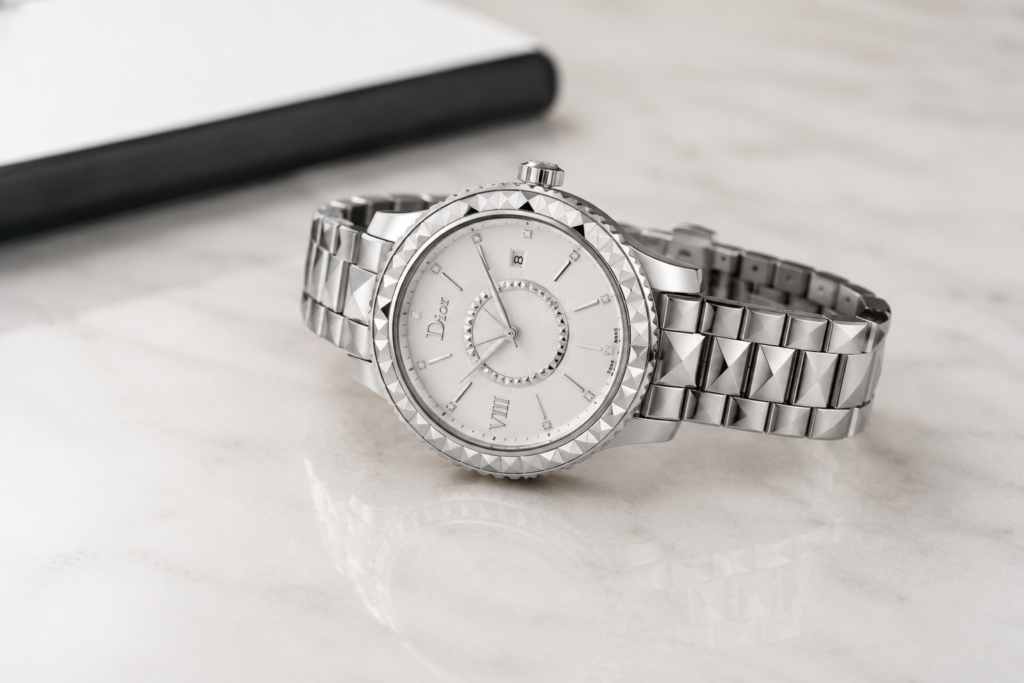
Retail approximately £3,500 to £7,000. Pre-owned pricing typically 50% to 70% below retail. The Dior VIII is a well-designed piece with reasonable mechanical content (ETA base movements in most configurations), but it competes in the secondary market as a fashion brand rather than as a watch brand, and the resale audience for fashion brand watches is materially smaller than for dedicated watchmakers at the same price point.
The 2022 Bubble: Watches That Crashed Hardest
The 2022 to 2024 watch market correction produced two distinct categories of loss: temporary underperformance from genuine investment-grade assets that had become speculative, and permanent value destruction from assets that had been priced on hype rather than fundamentals. Distinguishing between these is the most analytically important skill in watch investment.
The Patek Philippe Nautilus 5711/1A peaked at approximately $200,000 in early 2022 and corrected to approximately $108,000 by 2025, a 45% decline from peak. This looks like destruction; it is actually normalisation. The 5711/1A still trades at three to five times its final retail price of $33,710. A buyer who purchased at $33,000 retail in 2015 and holds today has compounded at approximately 20% annually over the entire period, through the bubble and the correction. The correction erased speculative premium; it did not erase investment return. That is a buying opportunity, not a disaster. Full analysis of the inflation dynamics underlying this is covered in How Inflation Affects Luxury Watch Prices: A Data-Driven Analysis.
The Rolex Daytona Panda was trading at over $50,000 in 2022 and has corrected to approximately $28,000. Again, this is mean-reversion from speculative excess, not value destruction, because the Daytona has a documented secondary market history that extends back decades and a structural demand profile that supports current pricing.
The category that experienced genuine permanent destruction in 2022 was the speculative tier of limited editions, celebrity collaboration pieces, and brand-new references from brands without collector track records, where the entire premium was momentum-driven rather than fundamentals-driven. These assets corrected and did not recover, because recovery requires a buyer pool willing to pay above retail, and that buyer pool never existed for these references outside the speculative moment.
The Fashion Brand Trap
Fashion house watches, with one consistent exception, represent among the worst capital deployments in the luxury goods market. The economics are structurally unfavourable in three ways.
First, retail pricing reflects brand premium rather than horological content. A Dior or Louis Vuitton watch at £5,000 is priced against the fashion brand’s positioning rather than against the movement, case construction, or watchmaking heritage it contains. The secondary market prices the watchmaking content, not the fashion premium, because the secondary watch market buyer is primarily a watch buyer. The fashion premium evaporates entirely.
Second, the buyer pool is narrow. Fashion watch buyers are typically primary buyers (gifts, personal milestones) rather than collector buyers who drive secondary market liquidity. The result is low volume, long sale times, and forced discounting to achieve liquidity.
Third, fashion houses release new models and collections continuously, obsoleting prior editions faster than watch-centric brands. The Rolex Submariner has been structurally unchanged for decades; each iteration inherits the collector equity of its predecessors. Fashion watches are seasonal goods marketed as luxury goods, and the secondary market prices them accordingly.
The consistent exception is Cartier, specifically the Tank and Panthère de Cartier, and the reason is specific: both are design objects with pre-fashion origins (1917 and 1983 respectively) and design histories that predate and transcend Cartier’s contemporary fashion positioning. The Tank Must in steel depreciates modestly, and the Panthère has appreciated 31.8% over five years. Neither is a Rolex, but both occupy a different category from fashion house watches. This distinction and its implications for women in finance are covered in full at Best Watches for Women in the Corporate World.
What Bad Watch Investments Have in Common
Six structural characteristics predict poor investment performance with high reliability. Apply this checklist before any purchase above £5,000.
High marketing spend relative to production volume. Rolex spends almost nothing on advertising relative to its revenue. Hublot and Jacob and Co spend heavily. Marketing budget creates awareness; it does not create scarcity. Where the marketing budget and the retail price are both elevated, the secondary market absorbs only the production value, not the marketing premium.
Celebrity and sports endorsement as primary value driver. Watches that derive primary visibility from celebrity association rather than horological heritage are priced on ephemeral visibility. When the ambassador moves on or the moment passes, the premium evaporates. The Hublot Big Bang’s value retention problem is partly structural to its marketing model.
Limited horological content relative to retail price. A watch retailing at £15,000 with a base-grade movement, outsourced case components, and standard finishing is priced on brand premium. When that brand premium does not translate to secondary market demand, the buyer absorbs the full premium as loss.
No controlled distribution. Scarcity-driven secondary market premiums require controlled supply. Watches available on demand at any authorised dealer in any quantity have no scarcity premium to support secondary market pricing above retail.
Weak secondary market infrastructure. A watch that cannot be authenticated easily, priced transparently, or sold through established platforms has inherently lower liquidity. Lower liquidity means forced discounting at exit.
High frequency of limited edition releases. Paradoxically, brands that release “limited editions” constantly create the opposite of scarcity. Each new release dilutes collector interest in prior releases and signals to the secondary market that supply is not genuinely constrained. For the complete framework for applying this checklist to any specific acquisition, see How to Analyse a Watch Like a Private Equity Deal.
Where to Check Before You Buy
Three data points that reveal a bad investment before you make it, available before any purchase through free tools.
Secondary market price relative to retail. On WatchCharts, check the current market price against the retail price. A watch trading at 30% to 50% below retail on the secondary market is telling you what the market thinks the watch is actually worth. That information is available for free before you pay retail.
Median days to sell. WatchCharts provides this metric for any tracked reference. The Rolex Submariner sells in 15 days. The IWC Portofino takes materially longer. A watch with a 60-plus-day median sale time is illiquid. Illiquid assets are worth less than liquid assets at equivalent prices because the exit carries a time cost and a forced-sale discount risk.
Transaction volume over the past 12 months. On Chrono24, search the specific reference and filter by sold listings in the past year. A reference with fewer than 20 completed transactions globally has insufficient price discovery to be treated as an investment asset. You are buying into uncertainty about what you will realise on exit, and uncertainty favours the buyer, not the seller.
For pre-owned acquisition in investment-grade categories, Watchfinder & Co. provides authenticated inventory with transparent pricing that reflects current secondary market levels, allowing direct comparison to the WatchCharts benchmark before any transaction.
Conclusion: The Capital Preservation Rule
The pattern across every reference on this list is the same. Retail price reflects brand marketing, celebrity associations, and fashion positioning. Secondary market price reflects secondary demand from watch buyers who evaluate horological content, brand depth, and collector track records. Wherever those two numbers diverge significantly, the buyer who pays retail absorbs the full difference as a loss at exit.
The capital preservation rule for watches is simple: before any purchase above £5,000, run the three data-point check. If the secondary market price is already below retail for the reference, the watch is a consumption purchase with a predictable cost. Buy it if you love it. Do not buy it as an investment. If the secondary market price is at or above retail, you are buying into an asset with structural demand. That is the starting point for a serious allocation decision.
The data is available, free, and decisive. There is no excuse for expensive mistakes in the watch market in 2026.
DialAndYield.com analyses luxury watches as alternative assets for finance professionals. All prices in GBP are indicative as of Q2 2026. Secondary market performance data sourced from WatchCharts, Chrono24, and publicly available secondary market analysis. Nothing in this article constitutes financial advice.